Hybrid ARM + RISC-V Architecture: Why RV1106 Beats Single-Core Solutions
Hybrid ARM + RISC-V Architecture
Hybrid ARM + RISC-V Architecture: Why RV1106 Beats Single-Core Solutions
Edge AI shouldn’t make us pick sides speed or battery life.
That’s the problem we kept hitting in our latest build. Every single-core processor forced a compromise. Either it was fast and drained power or efficient and too slow to react.
We wanted something that could wake up instantly, process video and AI on demand, and still last long on battery.
That’s when we came across the Rockchip RV1106 and it changed the game for us.
The "Why Not Both?" Chip
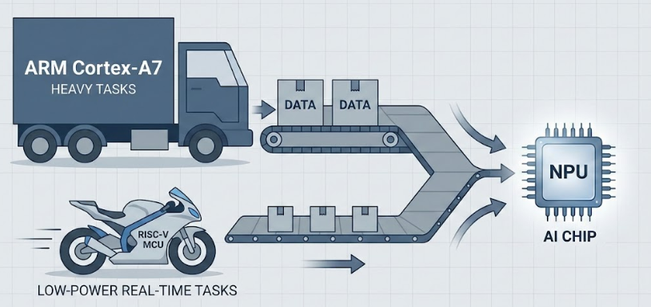
The RV1106 from Rockchip does something clever. Instead of forcing everything through one processor, it splits the workload between two different architectures working together:
- ARM Cortex-A7 running at 1.2GHz handles the heavy lifting
- RISC-V MCU (Syntacore SCR1) takes care of quick, low-power tasks
- NPU with 0.5-1.0 TOPS handles AI inference
Think of it like having both a truck and a motorcycle in your garage. Sometimes you need power, sometimes you need efficiency. The RV1106 lets you use the right tool for the job.
Where This Actually Matters
1. Boot Time That Doesn't Feel Like Boot Time
Our prototype camera system boots in about 250ms and can start capturing immediately. The RISC-V core wakes up fast, handles the basic initialization, and gets things running while the ARM core is still stretching its legs.
Traditional single-core systems? You're often waiting 2-3 seconds. That matters when you need instant response.
2. Power Efficiency Without Compromise
Here's where it gets interesting. The RISC-V core sips power we're talking milliwatts. For always-on monitoring or motion detection, it can handle the job alone while the ARM core stays asleep. When something interesting happens, it wakes up the big processor.
Single-core solutions are either always-on and power-hungry, or sleeping and slow to respond. Pick your poison.
3. Real-Time + Complex Tasks, Together
We run real-time sensor monitoring on the RISC-V side while the ARM handles video processing and AI inference. No conflicts, no bottlenecks. Each core does what it's good at.
Try that on a single Cortex-A7 and watch your real-time guarantees evaporate under load.
The Tradeoffs (Because Nothing's Perfect)
- Development complexity: You're essentially programming two different systems. The toolchain isn't as mature as pure ARM solutions. Documentation can be... sparse.
- Debugging: Issues that span both cores are fun to track down. Not "fun" fun. More like "why is it 2 AM" fun.
- Software ecosystem: ARM has decades of libraries and examples. RISC-V? It's getting there, but you'll write more from scratch.
When Single-Core Still Wins
If you're building something that doesn't need always-on capability, doesn't care about boot time, and runs straightforward tasks, a single ARM core is simpler. Less complexity, easier debugging, better community support.
The hybrid architecture shines when you need responsiveness, power efficiency, and performance all at once.
Our Take
After three months with the RV1106, we're converts. The initial learning curve was steep, but the benefits are real. Our battery-powered AI camera runs 40% longer than our previous ARM-only prototype, responds instantly to events, and handles complex inference without breaking a sweat.
Is it for everyone? No. Is it the future of edge AI? Maybe. Is it worth considering for your next project? Absolutely.
Have questions about implementing RV1106 in your projects? Drop a comment or reach out. Happy to share what we learned the hard way.
By Krishnan B
Technology Specialist
Embedded
No comments yet. Login to start a new discussion Start a new discussion