Why Cloud-Powered Thin Clients Could Transform Computing in India
How Thin Clients Work
Why Cloud-Powered Thin Clients Could Transform Computing in India
India is at an inflection point in digital adoption. As devices get more expensive and cloud infrastructure becomes stronger, thin clients—devices where the OS and applications run entirely on the cloud—are emerging as a powerful alternative to traditional laptops.
A thin client acts only as an interface. All the heavy processing, storage, and intelligence sits securely in the cloud. This simple shift can completely change how India accesses computing.
How Thin Clients Work
Modern thin-client solutions rely on:
- Cloud-hosted desktops / VDI
- Low-latency streaming protocols (RDP, ICA/HDX, PCoIP, etc.)
- Cloud CPU/GPU compute
- Centralised storage
- Lightweight OS on affordable hardware
The device is minimal; the cloud does the work.
Why This Model Fits India Perfectly
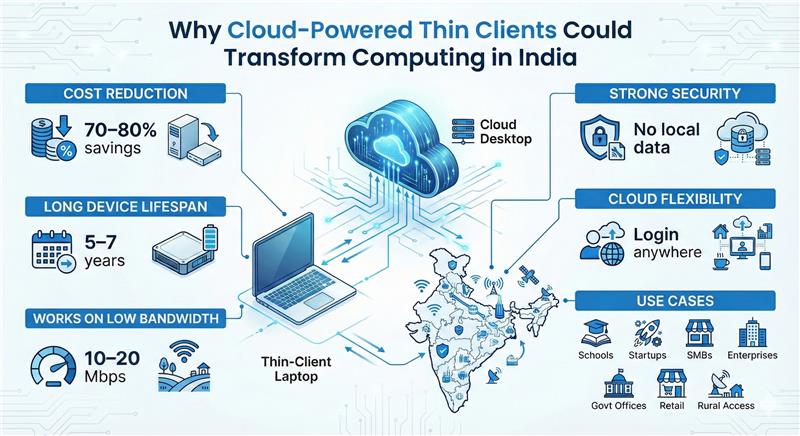
1. Dramatic Cost Reduction
Thin clients can cost 70–80% less than traditional laptops.
Perfect for students, startups, SMBs, and large-scale enterprise deployments.
2. Longer Device Lifespan
Since the cloud handles compute:
- No performance degradation
- Low maintenance
- 5–7 years of usable life
- No hardware refresh cycles
3. Works on Modest Bandwidth
Optimized protocols make cloud desktops smooth even on 5–10 Mbps — ideal for Indian network conditions.
4. Strong Security
No data resides on the device:
- Eliminates data theft
- Centralized patching
- Zero-trust control
- Great for enterprise, government, and education deployments
5. Cloud-First Flexibility
Users can log in from:
- Home
- Office
- A shared device
- A kiosk
Your entire desktop follows you anywhere.
Where Thin Clients Will Make the Biggest Impact
- Schools & Colleges – affordable computing at scale
- Startups & SMBs – no upfront hardware cost
- Enterprises – simplified IT management
- Government offices – secure digital workflows
- Retail & POS – reliable, low-cost endpoints
- Rural access points – consistent performance even on low-cost networks
The Future of Computing in India
With:
- Growing 5G rollout
- Falling cloud costs
- Increasing adoption of SaaS tools
- Rising need for secure remote access
Thin clients are poised to become the default computing model for millions.
This is the next logical step after smartphones: Affordable, flexible, secure cloud-powered desktops for all.
By:
Gopalakrishna N
Director of Engineering
Embedded
No comments yet. Login to start a new discussion Start a new discussion